
The benchmark Sensex companies' underlying earnings per share are down 3 per cent (on a cumulative basis) since January 2015, against 25 per cent rise in the index value during the period

Tata Motors shares fall 2%; m-cap erodes by Rs 5,521 cr.

'China is India's primary strategic challenge, which will not go away.

As stock markets continue to witness a dream rally, the total market valuation of domestic listed companies has soared to a record $1.6 trillion on a day the benchmark BSE Sensex ended at a new closing high of 28,177.88.

There seems to be no respite for Adani Group companies from the market carnage. All 10 stocks belonging to the conglomerate came under a fresh bout of intense selling pressure on Wednesday as the group's debt levels and repayment capabilities continued to plague investors. Analysts said investors are also concerned about whether the group will be able to maintain its pace of growth, given the current turmoil that has wiped out over Rs 12 trillion in market capitalisation (m-cap) since the start of the year.

Only TCS, Sun Pharma and HDFC notched up gains in their m-cap

Shares of RIL surged 4.42 per cent to its all-time closing high of Rs 1,082.20 on BSE.

Top 9 Sensex firms lose over Rs 1 trillion in market cap.

HDFC and ITC walk away with largest share of gains

Tatas' brand value grows 12% in the past year, far ahead of Reliance and Airtel.

In the top-10 ranking list of most valued companies, TCS stood at number one position followed by RIL, HDFC Bank, ITC, Infosys, HDFC, ONGC, CIL, SBI and HUL

The mid-and small-cap segments at the bourses have outperformed their larger peers thus far in fiscal 2023-24 (FY24). While the S&P BSE Small-cap index has surged around 5.7 per cent in FY24, the S&P BSE Midcap index has gained 4 per cent during this period. In comparison, the S&P BSE Sensex has moved up around 2.2 per cent.
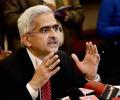
Reserve Bank Governor Shaktikanta Das on Monday said despite the latest headwinds arising from the Jackson Hole summit leading to extreme volatility, our banking system and financial markets are strong enough to withstand such pressures. Taking the markets by surprise, US Fed chair Jerome Powell had told the annual Jackson Hole summit of central bankers and economists last week that he would have to keep raising federal fund rates to tame inflation, which remains the biggest challenge to the world's largest economy. He also warned of the pains that such monetary policy actions would create on growth and jobs.

Riding on a strong stock market rally, Anil Ambani-led diversified business conglomerate Reliance Group has crossed Rs one lakh crore market valuation.


For being listed on the index a scrip must have the minimum free-float market capitalisation of Rs 100 crore.
The country's top 10 companies have witnessed an erosion of about Rs 72,000 crore (Rs 720 billion) from their market capitalisation in a week, with Reliance Industries' valuation again dipping below the Rs 2,00,000-crore (Rs 2,000 billion) mark.

Investors became richer by over Rs 6.34 lakh crore on Monday as markets gave a big shout-out to the Budget 2021-22, which analysts termed as 'unprecedented' against the backdrop of the pandemic-induced slowdown. Cheering the Budget proposals, the BSE benchmark Sensex zoomed 2,314.84 points or 5 per cent to close at 48,600.61. During the day, it jumped 2,478.63 points to 48,764.40. This was the best Budget-day gain for the markets since 1997, analysts said. Following the extremely positive market sentiment, the market capitalisation of BSE-listed companies rallied Rs 6,34,069.67 crore to Rs 1,92,46,713.70 crore.

The much-awaited upturn in the stock market on Thursday added more than Rs 1.17 lakh crore to investor wealth, which had plunged by over Rs 4.35 lakh crore in the past four days amid heavy sell-offs.

The collapse of Silvergate Bank, Silicon Valley Bank (SVB) and Signature Bank in the US might create temporary liquidity issues but will not have any significant impact on the Indian crypto market in the long run, officials from several exchanges told Business Standard. All three banks are considered crypto-friendly. SVB offered services such as cryptocurrency custody and lending.

'Starting an SIP now and continuing with it is likely to translate into high returns over the long term.'

These funds at times invest in companies going through corporate restructuring, such as mergers, demergers, or buybacks.

Investors' wealth on Tuesday jumped by over Rs 2.51 lakh crore, in tandem with a sharp recovery in equities after four days of heavy declines. The 30-share BSE Sensex opened on a weak note and tumbled 581.93 points or 1.10 per cent to 52,260.82 during the day amid firming oil prices and relentless selling by foreign institutional investors. Amid bouts of volatility, the benchmark touched a high of 53,484.26 and a low of 52,260.82 during the trade. It finally settled at 53,424.09, higher by 581.34 points or 1.10 per cent.

Zomato's mega initial public offering (IPO) ended with a bumper 38 times oversubscription on Friday as institutional investors poured money to get a pie of the hottest online food delivery platform. Zomato got bids for 2,751.25 crore shares against 71.92 crore shares on offer, stock exchange data showed. The IPO is India's biggest since March 2020. Institutional investors, who shied away in the first two days of the IPO, bid several times over the number of shares reserved for them.

The Pune-based Rahul Bajaj group, thanks to an amazing stock market ride by Bajaj Finance and Bajaj Finserv, has grabbed third spot, pushing the Aditya Birla group down to fourth position.

For the startup ecosystem in India, the scorecard so far has been a mixed bag, observes Akhil Gupta.

Ramalingam Kalirajan explains the pros and cons of both investment types.

From the 30-share Sensex pack, 23 scrips declined in Wednesday's session, led by IndusInd Bank, Bajaj Finance, Tata Motors and Tata Steel which fell by up to 3.87 per cent.

Investors added more than Rs 10.56 lakh crore to their wealth as markets continued their rally for the sixth straight session on Thursday. The BSE Sensex went past 61,000-mark for the first time ever on Thursday. It jumped 568.90 points or 0.94 per cent to its new closing peak of 61,305.95.

The combined market valuation of top seven Sensex companies tanked by a whopping Rs 1 lakh crore in the past week, with TCS, ONGC and RIL taking the steepest hit.

After declining for three consecutive quarters, the value of FPI investment in Indian equities rose 8 per cent quarter-on-quarter to $566 billion in the July-September period, according to a Morningstar report on Wednesday. A fast-changing global macroeconomic landscape, sentiments and opportunities that the Indian equity markets have to offer impacted the direction of flows by Foreign Portfolio Investors (FPIs). Through the quarter, the value of the FPI holdings in domestic equities surged by 8 per cent to $566 billion from $523 billion recorded in the previous quarter.

Manchester United said on Tuesday it was commencing a process to explore strategic alternatives, including a new investment or a potential sale, 17 years after the American Glazer family bought the English Premier League soccer club.
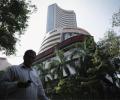
HDFC worst hit with Rs 9,177 cr erosion; Sun Pharma only firm to have come out a gainer

TCS is the country's most valued firm with a market capitalisation of Rs 687,123.96 crore

TCS ruled the domestic market cap chart in ranking, followed by RIL, HDFC Bank, ITC, Infosys, HDFC, CIL, Sun Pharma, HUL and ONGC
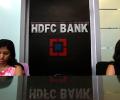
With Housing Development Finance Corporation's (HDFC's) merger with HDFC Bank becoming effective on July 1, the merged entity is set to become the top weight in the benchmarks S&P BSE Sensex and the National Stock Exchange Nifty indices, dislodging the country's most valuable company, Reliance Industries (RIL), from its perch. HDFC will stop trading after July 13. At present, RIL has a weighting of close to 12 per cent in the Sensex and 10.3 per cent in the broad-based Nifty. Meanwhile, HDFC Bank and HDFC have weights of 9.9 per cent and 6.8 per cent in the Sensex and 8.8 per cent and 6 per cent in the Nifty, respectively.

The Indian equity market has been dancing to the tune of foreign portfolio investors (FPIs) for more than two decades now. Typically, when FPIs are net-buyers on Dalal Street (D-Street) and raise their ownership of Indian equities, the broader market rallies. Conversely, when FPIs turn net-sellers, the stock prices decline. FPIs have been net-sellers on D-Street for five quarters on the trot and the result has been predictable.

'Investors should ideally consider equity allocations from a medium-to-long term perspective.'

The Tata Tech IPO will be the first from the Tata group since TCS listed its shares in 2004.
